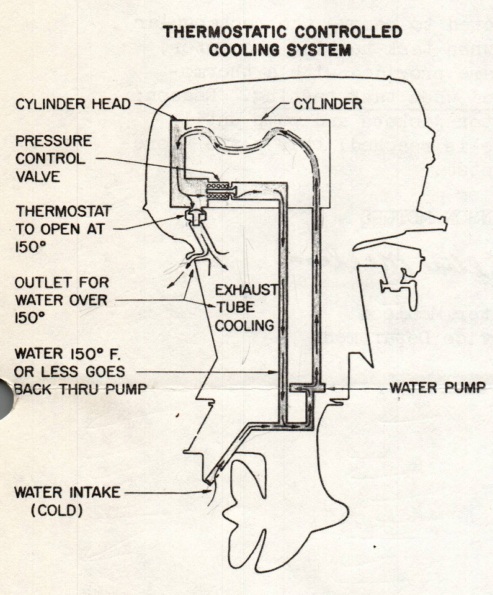
The 1958 Johnson RDS, V-4-10 and V-4S-10 models are designed with perhaps the most important improvement in outboard motor history - the thermostatically controlled recirculating water system.
Automotive engineers have known, for years, that internal combustion engines function most efficiently when operated at high, even temperatures. Johnson engineers have now developed a system similar in principle, recirculating the already warm water from the powerhead and discharging overboard enough warm water and admitting enough cold water to maintain the correct temperature. An automotive type thermostat which is under constant pressure allows a small amount of water and any air in the system to drain overboard thru a small bleeder hole located in the thermostat seat. Because of the resultant higher uniform operating temperature, you will find that these thermostat equipped motors will warm up faster, perform better, and will be more economical to operate.
For your information, the thermostat opens when the correct temperature is reached in the system, and enough water is discharged out thru the exhaust relief outlet to maintain the correct temperature. You will note that when operating in temperatures of 70° F or less, the hot water being discharged will create a very apparent vapor cloud when it comes into contact with the outside air. This is completely normal and does not indicate malfunction of the water system.
If no water or vapor is being discharged, stop the motor immediately - the water inlet slot is obstructed, there is a leak in the cooling system, or the water pump impeller is not functioning properly.
To determine whether or not the thermostat is operating properly, a tube thermometer may be inserted into the exhaust relief outlet - if the thermometer does not reach approximately 140° F, your thermostat is not operating properly and should be replaced. If the temperature exceeds 170° F, the motor is overheating and the same procedure should be followed as in any other motor which shows signs of overheating.
