SERVICE MGR.
SALES MGR.
PARTS MGR.
SERVICE MGR.
SUBJECT: BOTTOM FOULING AND BOAT PERFORMANCE
With the introduction of the higher horsepower engines, continuous maximum boat performance is expected by most of your customers. However, there is one contributing factor often overlooked by a large percentage of owners and dealers - - the condition of the boat bottom.
You are all probably aware of the effect of salt water on hulls, but how many are aware of the reduction in performance that occurs in so-called fresh water. We recently conducted some tests that were eye-openers. One thing you must understand, is that these results will vary with water and air temperature and according to the foreign matter present in the water. However, though the time period changes, the final loss in speed can occur almost anywhere, much to the despair of owner and dealer alike.
In salt water the growth is usually barnacles and other forms of marine life. In fresh water the growth is not conspicuous in the early stages. It will first appear as a light film of scum which can be felt easier than it can be seen. However, even this early stage of fouling can result in obvious loss of performance.
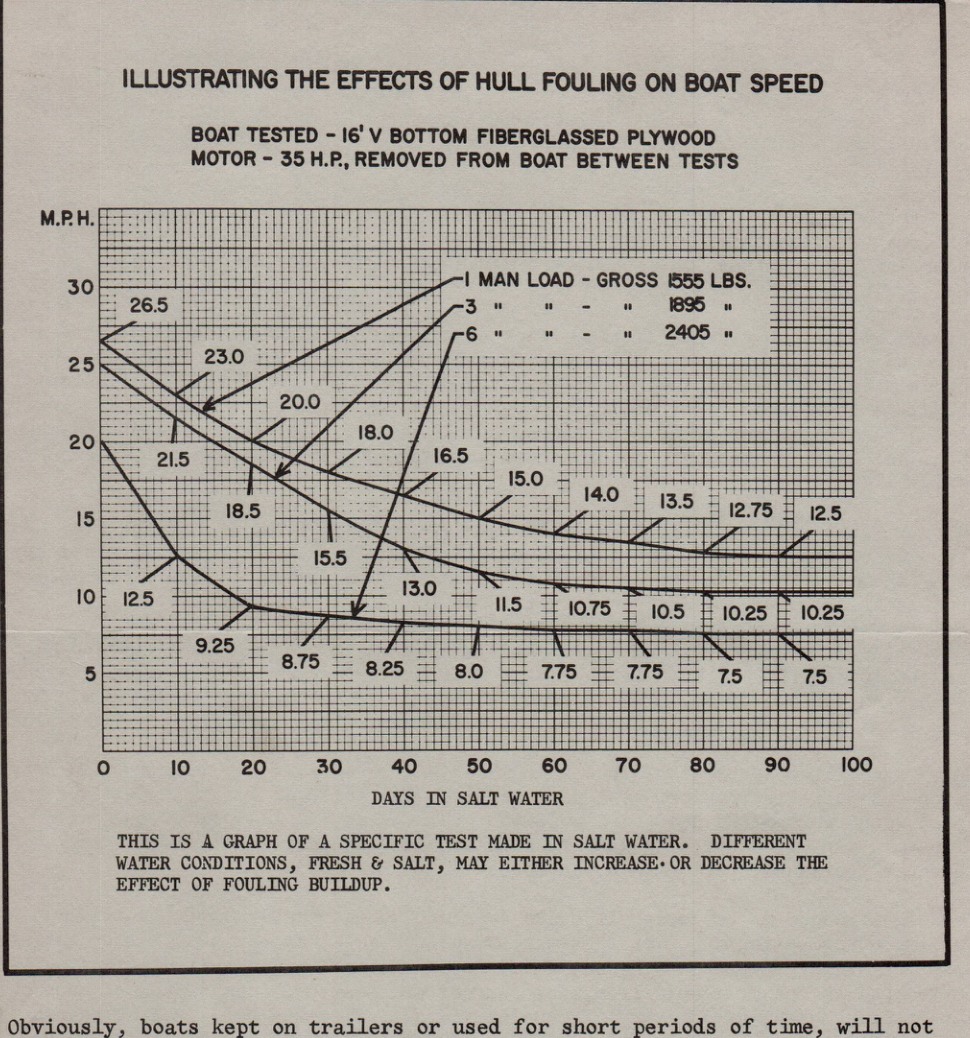
A 16 ft. boat was equipped with a 35 H.P. engine and performance was checked with various loads. It was then left in salt water and every week performance was checked again. At the end of 30 days the speed with one man had dropped almost 8 m.p.h. and with a six man load, a loss of 10 m.p.h. was recorded and the boat would not plane.
This was not too surprising since salt water was involved. The next test in fresh water was quite surprising. The same sequence was followed and after 30 days the speed with two men had dropped almost 6 m.p.h. A six man load showed a loss of almost 10 m.p.h., and planing was impossible. In each case when the hull was thoroughly cleaned, performance was restored.
The significance is obvious. If boats are left at mooring, they should have anti-fouling bottom paint in order that maximum performance can be maintained. This is true for all types of boats, wood, aluminum and fiberglass. Good anti-fouling bottom paints are available from many sources and most boat manufacturers provide anti-fouling paint as an extra. Acquaint yourself with the anti-fouling paints best suited for your waters and encourage your customers to use them.
Whenever you have complaints on gradual speed losses over the course of a season, don't condemn the motor before you first check the condition of the boat bottom. Just a light film of scum can drastically affect performance; see chart.
(over)