
July 22, 1960
Bulletin No. SB-789
SUBJECT: WATER IN CYLINDERS - 1960 V-75 ENGINES.
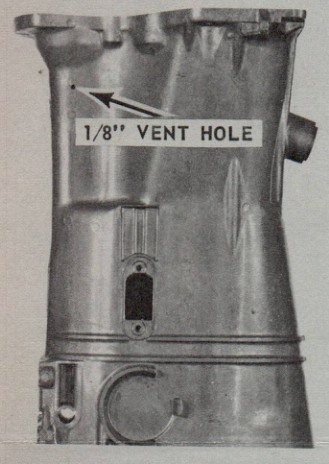
Figure 1
Exhaust Housing #307180
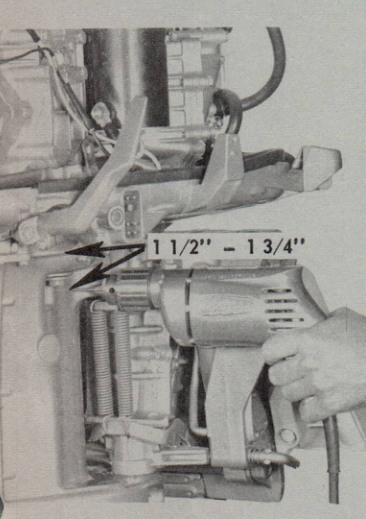
Figure 2
Many of you have, at one time or another, probably
experienced problems with water getting into cylinders on
some 1960 V-75 engines. As a result of field complaints,
engineering tests were conducted which verified this
possibility.
The problem is easily remedied by the simple expedient of
drilling a 1/8 inch hole into the driveshaft tube contained
in the outer exhaust housing, part #307180, figure 1. This
hole then relieves pressure build-up by venting the drive-
shaft tube, thus preventing water from passing between
lower carbon seal #305119 and the crankshaft, into the
crankcase, and finally into one or more cylinders.
Drilling a 1/8 inch hole can be accomplished by drilling
through the walls of both the exhaust cover and outer
exhaust housing, either side, without the chore of dis-
mantling any part of the engine as follows:
1. Pivot engine to one side or the other.
2. Locate point of drill bit 1½ to 1¾ inches below
top mounting flange of the front exhaust cover,
part #305417, as illustrated, figure 2.
3. Position drill at approximately a 45° angle from
front of engine and drill straight through both walls
into driveshaft tube of exhaust housing 307180, figure
1. Ease drill through each wall to avoid drill bit
breakage. DO NOT DRILL INTO EXHAUST TUBE OF HOUSING
#307180!
1960 V-75 engines after, and including, the serial
numbers listed below received the drilling operation
at the factory. However, since only the outer exhaust
housing, part #307180, has been drilled, the vent
hole is NOT visible in exhaust housing cover 305417.
Such invisibility constitutes no cause for concern
and should be disregarded as long as the engine's
serial number is above the following numbers. This
difference between field modified and production
engines in no way adversely affects appearance or
performance.
V4S-12 Serial #2139119
V4SL-12 Serial #2142351
(over)