July 28, 1960
Bulletin No. SB-790
SUBJECT: THERMOMELT TEMPERATURE STIKS
With the introduction of the thermostatically controlled cooling system on our newer
engines, many dealers have requested some means of measuring the water temperature of
an engine in order to check the operation of the thermostat.
Our factory test cells have been using heat sensitive sticks, similar to a crayon, with
great success. We have investigated these sticks and are now able to offer you a
similar heat indicator called "Markal Thermomelt".
Checking the heat of an object with the Thermomelt Stik is very simple. Merely mark
the surface to be checked with the Stik. The mark will appear dull and chalky. When
the surface temperature reaches the temperature rating of the Stik, the mark becomes
liquid and glossy in appearance. On some painted surfaces the stiks will not leave a
mark. It is only necessary to touch the surface with the Stik in these cases. The
reaction will be the same if the surface is to the rated temperature.
To check an engine, it is merely a matter of warming up the engine and checking the
heat of the water at a specified location. The engine is best checked when operating
on a boat. However, if this is not possible, run the engine in a test tank for at
least five minutes. (NOTE: Do not run engines rated at 40 H.P. or higher in a test
tank at speeds over 3000 RPM for extended periods under any conditions.) Warm-up can
be accomplished satisfactorily at this RPM.
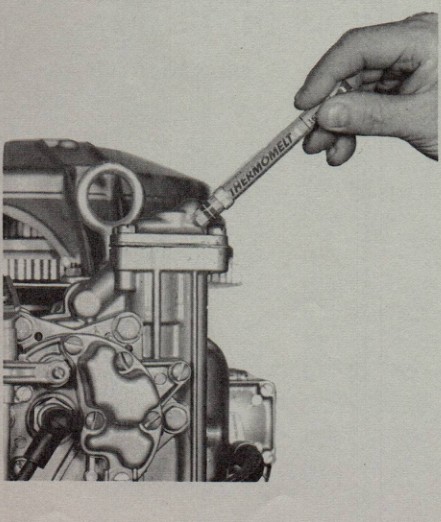
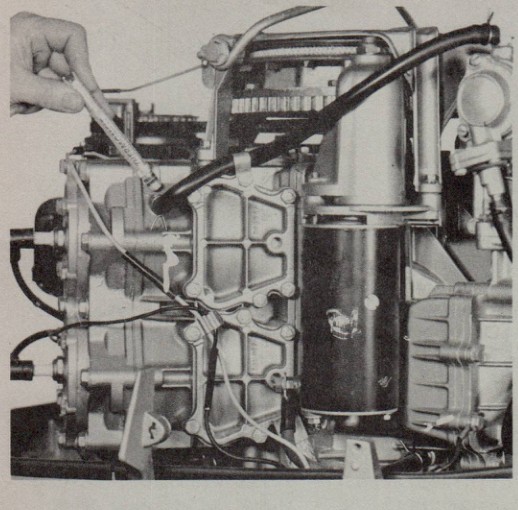
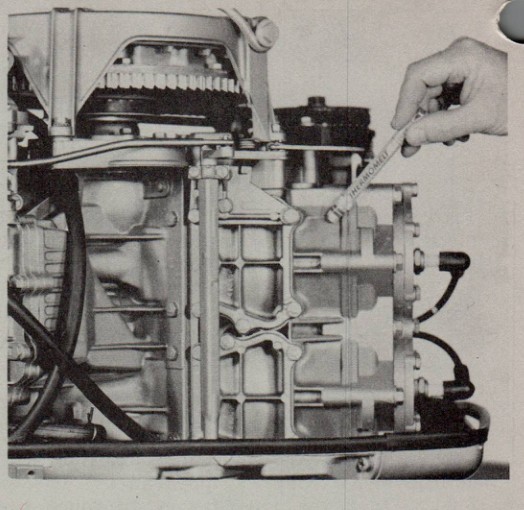
Two Thermomelt Stiks are necessary to check an
engine - a 125° F Stik and a 163° F Stik. Mark the
engine to be tested on the thermostat housing as
shown in Fig. (1), V4 engines are marked on each
cylinder bank as shown in Fig. (2) and Fig. (3).
When the engine warms up, the 125° mark should melt
and the 163° mark should not melt.
If the 125° mark does not melt after a reasonable
length of time, the thermostat is stuck open as the
engine is running too cold.
If the 163° marking also melts, the cooling system
is not functioning properly allowing the engine
to overheat. Check for worn pump assemblies,
leaky water systems, or faulty thermostats.
If the Thermomelt Stiks will not mark the surface
to be checked, touch the Stiks to the area several
times to be sure engine is warmed up completely
for a proper check.
Figure 1
(over)