
July 29, 1960
Bulletin No. SB-794
SUBJECT: OVERHEATING - FLASH REMOVAL; 40 and 75 H.P. ENGINES.
Recently we have found that a few cases of over-
heating were due to partially blocked water passages
in the cooling system. The restriction, known as
flash, is a thin film of metal sometimes formed in
the process of die-casting. This flash must be
removed for proper engine cooling and should be
checked in all cases of overheating reported by a
customer.
The long arrow (Fig. #1) shows where flash might be
found in the 40 H.P. exhaust housing (part No. 377988).
With the powerhead and/or lower unit and watertubes
removed, this may be checked from either end of the
housing by looking into the water passages with the
aid of a flashlight. If inspection shows either of
the passages restricted, the metal should be removed
using a shift rod or similar stock to knock it out.
Be sure the metal removed, does not lodge in the
exhaust housing, as it might cause further restriction
when the engine is re-assembled. (NOTE: Do not damage
the small fins in the housing (short arrow, fig #1).
These serve as a stop for the water tubes when
assembling the lower unit.)
Figure #2 shows the 75 H.P. powerhead to lower unit
adapter (part No. 377970) partially cutaway to show
possible location of flash (arrows, Fig. #2) which
would cause overheating. This can be easily checked
as follows:
1. Remove the rear exhaust housing cover.
2. Remove the thermostat housing.
3. Insert a rod (approximately ¼" in diameter)
into the passages in the direction of the arrows.
4. If the rod will not go into the passages at least
as far as shown, they are blocked and the adapter should be removed and replaced.
Also, be sure to check for these condition on all service parts you now have in stock.
JOHNSON MOTORS
W. W. DeWees
Service Department
WWD:eb
NOTE: Post on your RD and V4 series index - 40 & 75 H.P.
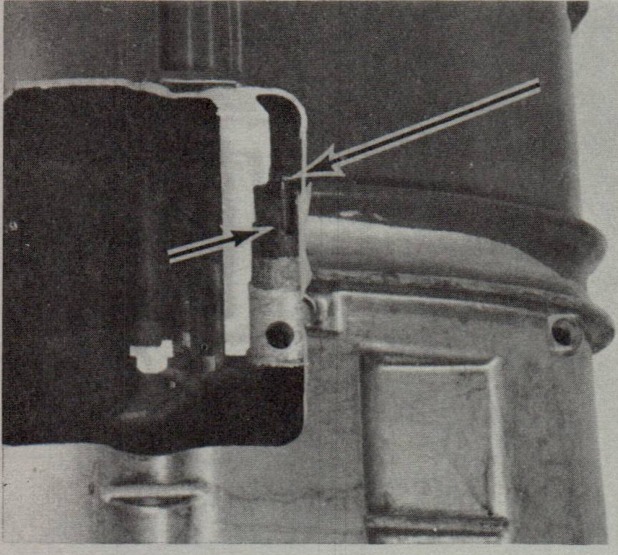
Figure 1
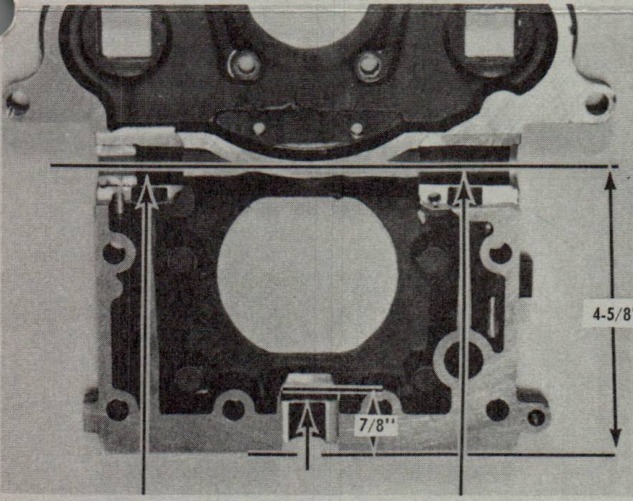
Figure 2
W. W. DeWees