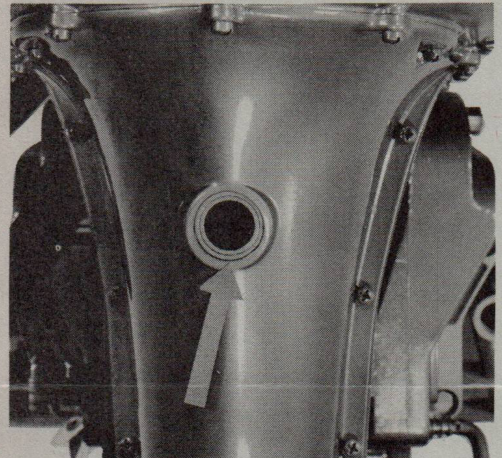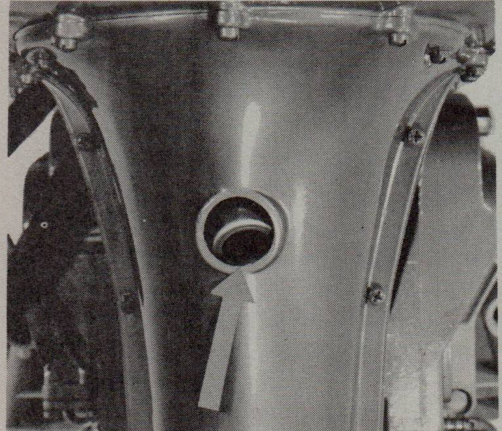
June 28, 1961
Bulletin No. SB-853
Trouble Shooting
SUBJECT: Engines inducting own exhaust gases through carburetor cause ...
(a) RPM loss at full throttle, and/or
(b) Rough idling (supplement to SB-838)
35 h.p. models RD thru RDSL-21 & 21B;
40 h.p. models RD thru RDSL-22 thru 23;
50 h.p. models V4 thru V4SL-10 thru 11B;
75 h.p. models V4S & V4SL-12 thru 13C;
75 h.p. models V4A & V4AL-13 thru 13F.
RPM LOSS AT FULL THROTTLE OPERATION: From time to time reports have been received that some engines would lose rpm while running on boats at full throttle with the shroud's front door closed. Upon opening the door, the engine would regain the specified full-throttle rpm until the door was again closed whereupon rpm loss returned.
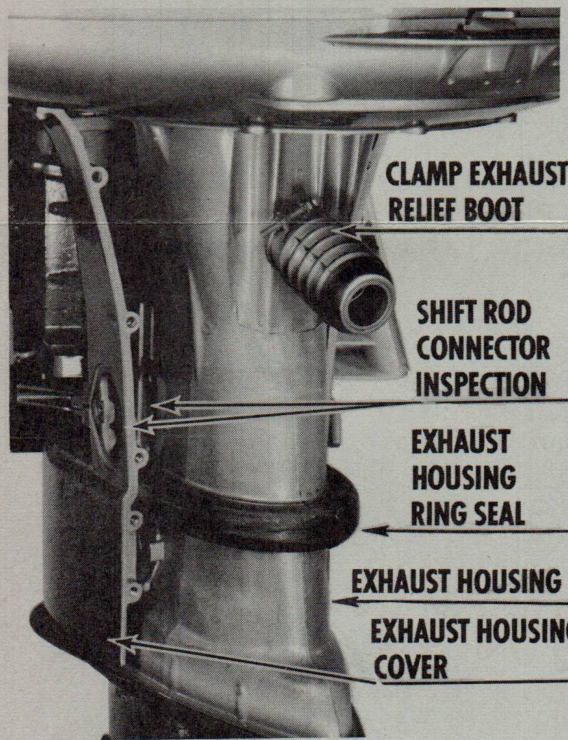
FIG. 1 - Illustrating location of exhaust housing ring seal on V-75 engines. Typical of subject 35, 40 & 50 h.p. engines except on 35 & 40 h.p. models shift rod connector inspection is on starboard side and ring seal is located above inspection holes.
Cause and effect: While there are many reasons for engines losing rpm at full throttle, we have determined the foregoing situation is frequently the result of damaged exhaust housing ring seals, figure 1. When this seal is damaged in such a manner that it fails to completely seal the space between the outer exhaust tube and the exhaust housing covers, a path is provided up to the powerhead through which the engine's own exhaust gases can pass and ultimately be inducted through the carburetor. This induction of exhaust fumes (carbon monoxide) unbalances the fuel/air ratio which tends to starve the engine of the oxygen required for efficient combustion. As a result, engine speeds may occasionally drop as much as 2000 rpm depending upon the amount of exhaust fumes inducted; (only a very small amount is required to accomplish this). Upon opening the front door the fuel/air ratio again becomes balanced to the engine's requirements which in turn restores full-throttle rpm.
Remedy: Note that opening and closing the shroud's front door is an indication the engine's exhaust housing ring seal may be damaged. Whenever you receive customer complaints of rpm loss at full throttle, first check the complaint by alternately opening and closing the front door. If rpm are lost with the door closed but are regained so the engine runs at the specified rpm with the door open, check the condition of the exhaust housing ring seal before checking other possibilities such as ignition, carburetion, compression, etc. Should inspection reveal a ring seal damaged so as to allow the slightest amount of exhaust gases to