A CHECK ON FUEL TANK PRESSURE
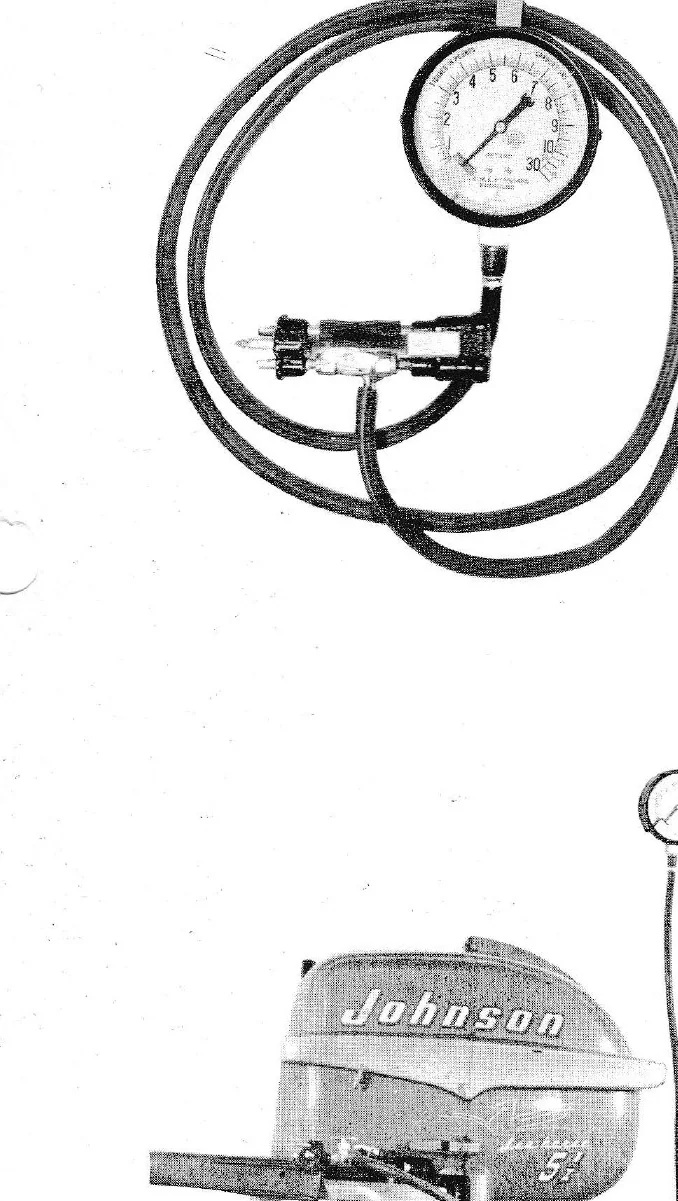
Illustrated here is a pressure gauge assembly produced by The Stevens Experimental Company
for running a check on fuel tank pressure to
be assured of constant fuel supply. While motors of recent production (except JW) are provided fuel pumps, there are still thousands of earlier production in use with the pressurized fuel system installation.
It's a rather simple arrangement consisting of a low pressure gauge, about eight feet of rubber tubing with fi'ings at each end for a'aching to the motor and to the fuel tank and a vaive to close off pressure to the
tank, if desired.
The illustration will reveal how it's used - simply place in a convenient position near the test tank - the air pressure line is long enough to permit "hanging" the gauge on a close-by wall (do not a'ach to the tank). Gauge must be mounted in a vertical position.
I'm sure you'll find this a helpful piece of shop equipment well worthwhile considering. Order directly from:
STEVENS EXPERIMENTAL COMPANY 2015 Grand Avenue, P.O. Box 119 Waukegan, Illinois
Your cost is $11.50 F.O.B. Waukegan, Illinois.
Along with checking out a motor for possible causes of unsatisfactory performance -- slow and high speeds - condition of the fuel tank is frequently overlooked. Its primary purpose, of course, is to "hold't pressure as pressurized by the crankcase valving mechanism. Failure to retain pressure obviously is a signal of "seepage or pressure escape which when reaching a certain limit, has its effect on motor performance -- inability to maintain proper fuel level in the carburetor.
SPB #274 - Continued
First, "check-out"t of any motor in for service and provided with a- pressurized fuel system should be accomplished with the "owner's" tank - the tank used with the motor.
"Falling-off" of pressure as indicated by needle "dip" when stopping the motor denotes pressure seepage in proportion to rate of the falling needle.
Failure to build up and hold sufficient pressure after a check of the tank, fuel line and fuel line connections for possible seepage, may otherwise result from faulty crankcase valving. In this event, start and run motor for a minute or so to build up gauge pressure - close valve in assembly. Should the needle indicate an abrupt or gradual "dip", crankcase valving may be suspected of seeping which must be corrected to restore normal functioning of the motor. Each tank should build up and retain pressure as follows:
Model CD 3 - 4½ pounds
Model QD 3-5 pounds
Model RD 3 - 4½ pounds
 Jack Penland
Service Promotion Manager
As an Amazon Associate I earn from qualifying purchases.