
WHY A TEST WHEEL FOR TANK AND DOCKSIDE TESTING
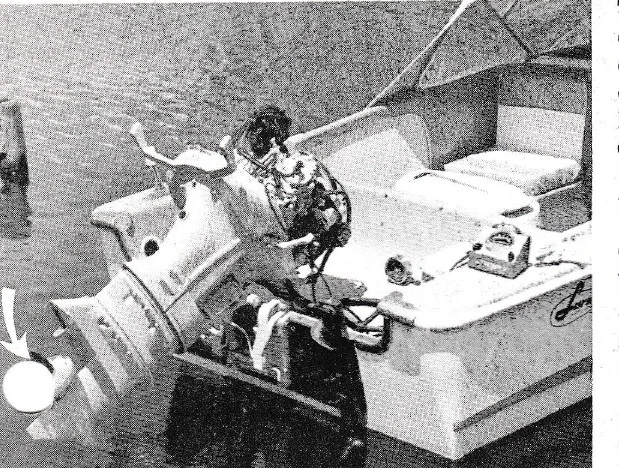
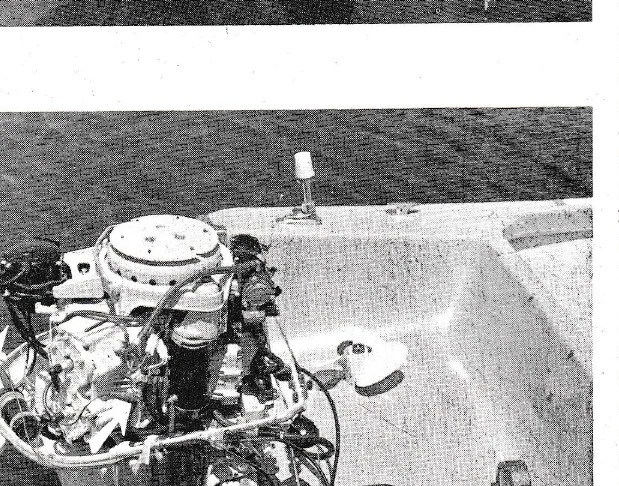
The function of final testing and tuning of any outboard motor is best performed under actual conditions - on a boat in open water where all conditions of normal operation may be observed. But, it's not always possible or convenient to do so because of the time consumed and more often, inaccessibility to water edge - thus, the propeller test wheel for tank use.
The use of test wheels however, need not necessarily be confined to the shop test tank. Quite often and under certain conditions it becomes advantageous to run a check of motor performance at dockside without removing the motor from the boat.
Should the occasion arise, anchor the boat firmly to the dock, making certain of ample water around and below the gearcase for test wheel running. Remove the propeller to install the test wheel. Attach the tachometer leads in the usual manner. Start and run motor to observe performance characteristics - keeping in mind desired operating range (RPM) for the specific model.
Dockside test running in this manner provides an excellent opportunity to accomplish final adjustments and tuning - also, an opportunity to check remote control adjustments, overall rigging and the electric harness/junction box installation.
It is a known fact that propeller thrust, the force required to drive the boat, is greatest at full throttle between the time the boat starts to move and the instant at which it breaks over to assume planing position - point of greatest thrust. On having reached the planing position, propeller thrust for a moment falls off abruptly but commences to gradually build up again as boat speed accelerates and engine RPM approaches the range established for best performance - normal operation for the particular unit.
With this in mind, each of the available Johnson propeller test wheels have been designed,
SPB #290 - Continued
constructed and calibrated for each specific model horsepower range to simulate in the test tank, as nearly as possible, thrust and load condition approximating those encountered during normal overall performance of the motor and at which time all final adjustments and tuning should be accomplished for maximum results.
Any attempt to check out or tune a motor laboring at low RPM in the shop test tank or at dockside because of the "regular" propeller installation is futile and wasted effort which serves no purpose. RPM must be "up" to correctly perform required adjustments - particularly so, the slow and high speed carburetor needle settings.
In view of the high speed needles having been removed from the 1961 RD and V4 series carburetors and replaced with fixed jets, test tank running within the desired RPM range becomes significantly important since the jets are calibrated accordingly for best performance.
See test wheel performance chart and the list of propeller test wheels appearing on the order form enclosed.
Minimum desired RPM shown for each model is average minimum for test running with the properly designated test wheel installed at 600 feet above sea level (Waukegan, Illinois) in a tank 60" x 60" x 40" filled to approximately 565 gallons water capacity.
Several variables other than mechanical fitness however, enter the picture to affect testing performance such as:
1. The type and size of test tank and resultant turbulence created by the rapidly turning test wheel.
2. Dissipation or dispersion of exhaust gases from the tank.
3. Area elevation above sea level and,
4. Atmospheric conditions (barometric principally) at time of testing.
Using the chart as a guide, average tank performance (RPM) locally should not be too difficult to determine - simply by recording performance of several of each model as the occasions present themselves to establish an average of all recordings (of each model).
Keep in mind too that any internal combustion engine fundamentally develops its maximum horsepower at sea level where the air taken in with fuel vapor for combustion is denser than at higher than sea level elevations. Developed horsepower tapers progressively off at approximately 3% per each 1000 ft. of elevation up to 8,000 ft. or so.
Constantly changing atmospheric conditions (barometric and humidity) in a like sense have their effects on engine performance; increased RPM to a minor degree on a high barometer - lesser on a low barometer. Variations of 100 to 150 RPM may perhaps be noted when testing or during normal operation of the motor for that matter as result of changing atmospheric conditions.
Be guided by the test wheel chart when testing or tuning in the test tank or at dockside while taking note of the above mentioned variables.
Sincerely,
JOHNSON MOTORS
Jack Penland
Service Promotion Manager
As an Amazon Associate I earn from qualifying purchases.