
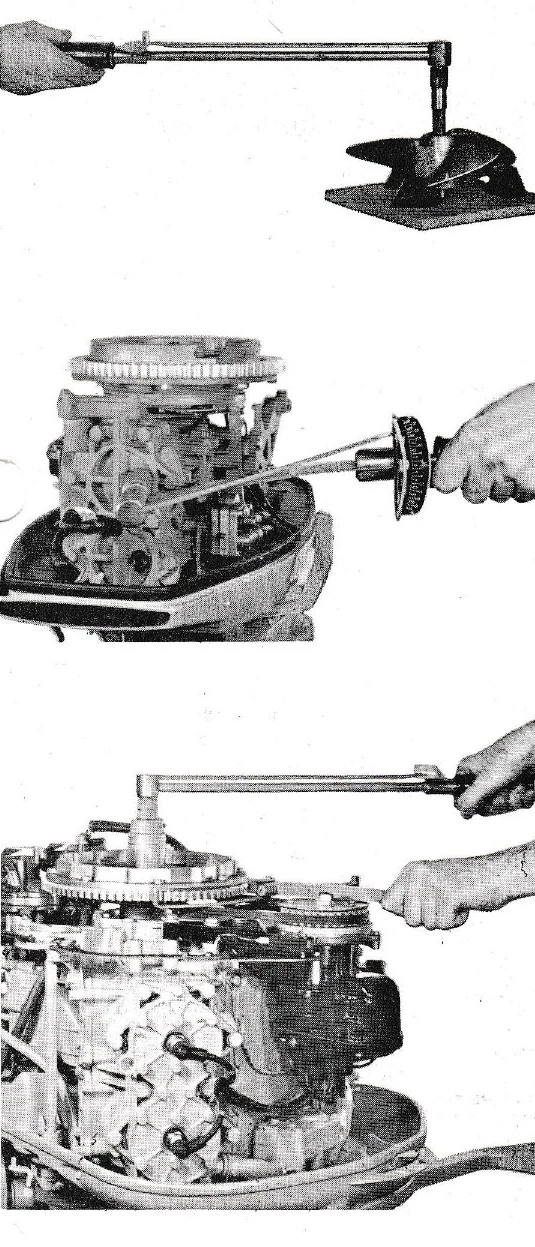
All nuts, bolts and screws are drawn up or tightened by means of torque ~ a twisting motion exerted by wre or screw driver, usually relying upon the individual! personal judgment as to degree of tightening.
With modern application of advanced design and con- struction, however, specific torque tension (tightenil applied to each group of screws, bolts or nuts in the assembly becomes a significant factor in the overall job - original assembly and/or repair.
All nuts, screws or bolts (flywheel, connecting rod, cylinder head, etc.) obviously cannot be drawn up to the same degree of tightness for several reasons — but mainly because of application, material used in construction, the type of threads, etc. For example, one screw or bolt may be considerably larger than another, yet specified torque tension for tightening may be greater for the smaller diameter screw - it was designed for a definite purpose with all details surrounding its installation engineered accordingly.
The old days of "nuts and bolts simply being nuts and bolts" are gone forever - todays practice demands drawing to specific torque tensions. See Service Bulletin #816.
Torque is measured in foot pounds ordinarily but frequently gauged in inch pounds, depending largely upon the circumstances involved. Just to remind you, one foot pound of torque tension is equal to resultar force of a one pound weight placed at one foot from a flucrum or pivot or at 12 inch pounds if the inst- rument is gaged in inch pounds.
Torque wrenches are available and calibrated accord- ingly ~ either in foot or inch pounds as required for the purpose.
Nothing is gained by pulling up beyond specified torque (tightness) recommended for the particular, nut, screw or bolt, The torque wrench is your quide | it tells you when correct tightness has been reached for the application, Stretching beyond the yield point of material and/or threads, simply weakens the installation to result in eventual failure.
 Jack Penland