Johnson Motors Service Promotion letterheadSPB-#385

August, 1966

SUBJECT: FAST, EFFICIENT CARBON REMOVAL

There are various methods employed to accomplish the job of carbon removal. Illustrated in this bulletin is a method we have found to be very effective, fast, efficient and profitable.

The particular tools used to illustrate this bulletin were loaned us by the various manufacturers of same. We are not in any way endorsing the trade names involved. However, care should be exercised to maintain their specifications.

The pneumatic drill used is a two to three thousand R.P.M. tool manufactured by the Chicago Pneumatic Tool Company. The advantages of a pneumatic tool particularly lend themselves to decarbonizing because this task demands continuous tool operation for a sustained period of time and the loads imposed on it, even by an experienced operator, frequently reach the stalling point. Continuous operation and stall producing loads are neither dangerous to the operator of a pneumatic tool nor harmful to the tool itself, as they can very easily be to an electric tool and its operator. This accounts for a third advantage of the pneumatic drill which is very low maintenance cost.
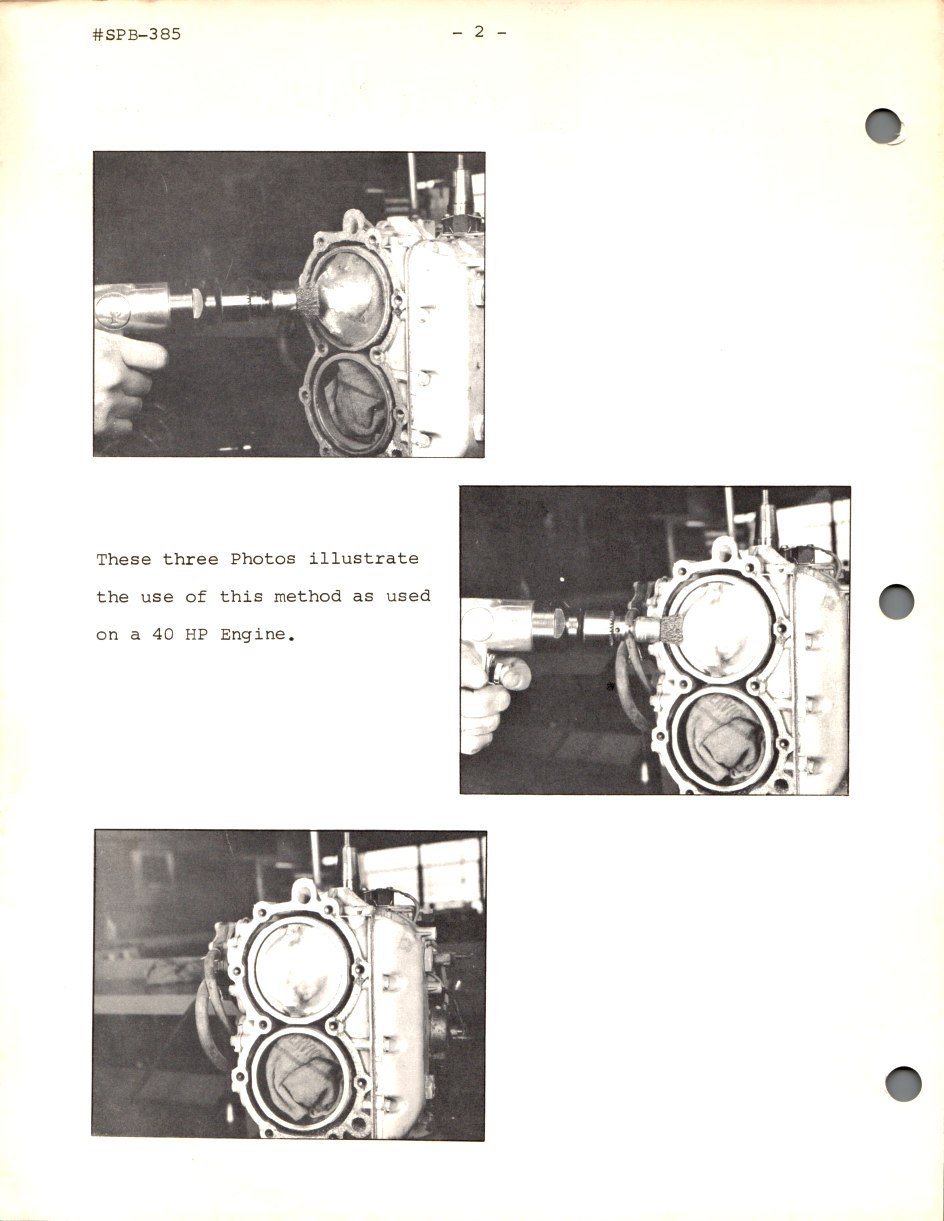
Original SPB 385 page 2 photographs of carbon removal on a 40 HP engine

#SPB-385    - 3 -

Assuming that you have an air compressor with adequate capacity to handle the CP-788D, an analysis of how this tool can be a money maker for you when used for carbon removal, was determined as follows:

I. DETERMINATION OF FIXED COST

CP-788D Pneumatic Drill$79.50 Net
Full Face Shield*5.95 Net
$85.45

II. DETERMINATION OF VARIABLE COST

3315 Milwaukee End Brush$1.34
3323 Milwaukee End Brush1.78
3.12
Less Discount on orders of 2 or more1.25
Brush Cost for 4 engines1.87
Brush Cost per engine.47
Labor Cost per engine1.50
Total Variable Cost per engine$1.97

Since the degree of wire brush stiffness and coarseness has a very definite effect on this process, a list of wire end brushes and their respective manufacturers has been included in this bulletin. The brushes listed have been found to be adequate for carbon removal in relationship to the RPM range of the CP-788D and yet, when used with reasonable care, will not be damaging to the engine.

*A FULL FACE SHIELD IS A RECOMMENDED PIECE OF EQUIPMENT FOR THIS OPERATION.

#SPB-385    - 4 -

WIRE END BRUSHES

MANUFACTURERPART NUMBERBRUSH DIA.BRUSH LENGTHWIRE SIZE
OSBORNE Manufacturing Co.
5401 Hamilton Avenue
Cleveland, Ohio 44114
98S6 104
98S 104
98S 72
1/2"
1/2"
1/2"
3/4"
1"
1"
.0104"
.0104"
.0104"
MILWAUKEE
Quality Brushes & Brooms
2236 North 30th Street
3315
3317
3323
1/2"
1"
3/4"
1"
1"
1"
.014"
.014"
.014"

Osborne & Milwaukee End Brushes are available from:

Caldwell Mill Supplies, Inc.
105 Greenwood Avenue
Waukegan, Illinois 60085

CP-788D
PNEUMATIC DRILL SPECIFICATIONS

Recommended Minimum Compressor - H.P. - 1 HP

Average Air Consumption - 4 CFM

Recommended Air Hose Size - 3/8"

Air Inlet (FPT) - 1/4"

Suggested List Price $79.50

#SPB-385

#SPB-385    - 5 -

If you operate on a flat rate basis and charge for your labor at the rate of $5.00 per hour, this would result in a labor charge of $10.00 for removing the carbon from a typical V-4 engine. (2 hrs. Flat Rate Time x $5.00/hr. = $10.00).

Actual field trials of the CP-788D have demonstrated that a complete carbon removal job can be done on a typical V-4 engine in slightly less than 1/2 hour. A time savings of 1-1/2 hours per engine is thus effected.

Due to the use of flat rates, your total labor charge to the customer remains unchanged and the total revenue that you take in for each job remains unchanged. Your increase in profit as a result of using this tool for carbon removal is a result of the 1-1/2 hours saved in performing this job.

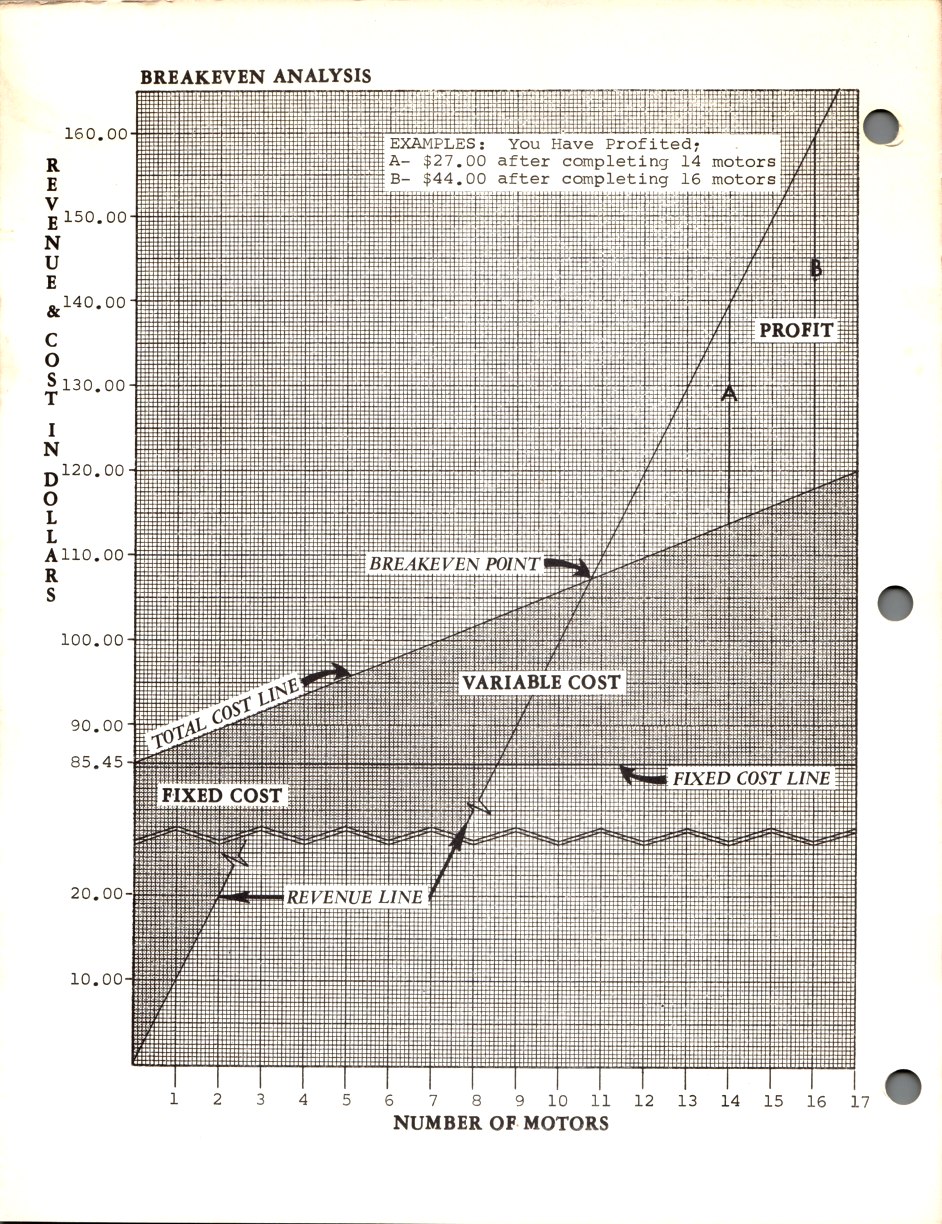
The total tool cost (Fixed Cost), the total labor and brush cost per engine (Variable Cost) and the total income that you receive from each carbon removal job (Revenue) is shown on the following Breakeven Analysis Graph. This graph is nothing more than a breakeven analysis that indicates how many decarbonizing jobs the equipment would have to do before it pays for itself.

You can see by looking at the graph that the cost of this tool is recovered by the time that 11 V-4 engines have been decarbonized.

The example used here is, of course, slightly simplified and hypothetical, but the assumptions made in it are all valid. The breakeven point, in this case determined by a certain number of engines, will vary with changes in the Fixed and Variable Costs and the Revenue received for each decarbonizing job. The same type of analysis could be adapted to any dealer's specific situation, however, so that he could calculate how many engines he would have to decarbonize in order to recover the cost of the equipment used in this decarbonizing procedure.

JOHNSON MOTORS

J. R. Penland
Service Promotion Manager

JRP:rs

Original SPB 385 page 6 breakeven analysis graph