Subject: Voltage Regulators
Models: 1978 thru 1980 V-4 & V-6 Outboards
Under certain operating conditions, there is a possibility of the alternator overcharging on the above listed V-4 & V-6 models which were built without voltage regulators. This may be especially severe on boats using two engines and one battery. Be aware of the several symptoms of overcharging.
The first is an overcharged battery (ammeter indicates continuous maximum charging, a battery that fails prematurely or one that is chronically low on electrolyte). This may show up on a boat that has been run for long periods with little or no use of electrical accessories.
Another is a high temperature gauge reading on an engine that checks out okay when tested with a Thermomelt Stik. Excessive voltage output causes the sensing device on the temperature gauge sending unit to heat up, causing an inaccurate temperature reading. High voltage output may also affect light bulb life or instrument performance or durability.
If you have a V-4 or V-6 with one or more of these conditions, you may want to consider the installation of the voltage regulator, P/N 173640. Use the following procedure to test regulators on motors that have a voltage regulator installed.
With the regulator, there can be only two types of failure: no output, resulting in an undercharged battery, or no regulation, resulting in an overcharged battery. Tests for either condition must be performed with a fully charged battery and with the motor operating at 4300-4600 RPM.
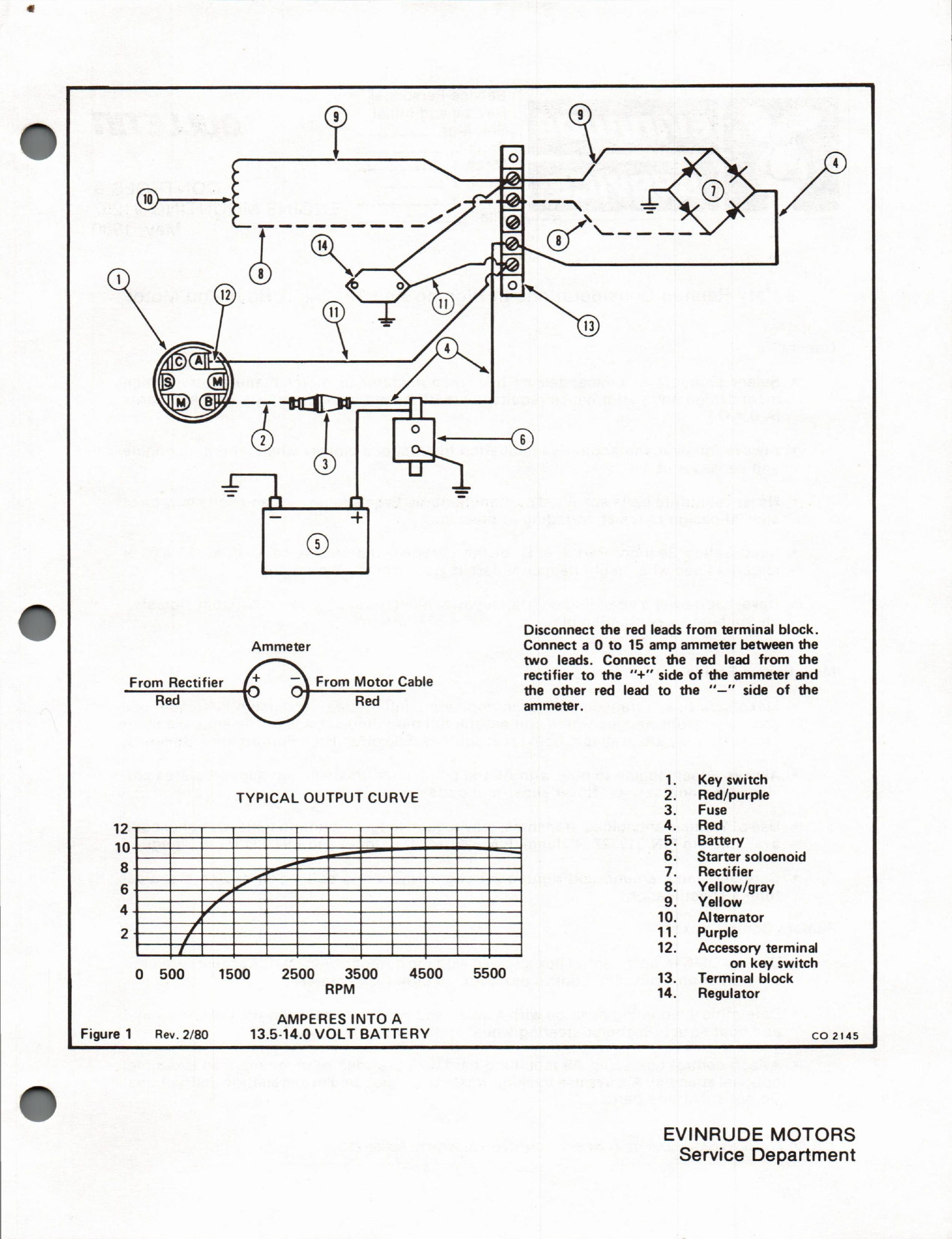
Undercharged Battery - If the battery is undercharged, stop the motor and disconnect the yellow regulator lead at the terminal block in the regulator circuit. See Figure 1. Connect ammeter.
Note
Make sure that all accessories are turned off; uncontrolled voltage could damage accessories.
Restart motor and run at 4300-4600 RPM. If ammeter now shows full charge, stator windings, rectifier and wiring are good and regulator must be replaced. If there is still no ammeter reading, check stator windings and rectifier per Service Manual instructions.
Overcharged Battery - If the battery is consistently overcharged (ammeter indicated continuous maximum charging, or battery uses excessive water), check the battery voltage (no load). Run motor at least 20 minutes to stabilize regulator.
If battery voltage is in excess of 15.5 volts with a known good battery, the regulator should be replaced.