SB-#1256
March, 1971
SUBJECT: SHORT SPARK PLUG LIFE
MODELS: 1971 50 H.P.
If you should receive a complaint of short spark plug life and the normal troubleshooting procedures do not reveal the cause of the problem, remember that short plug life may be due to a weak spark at the spark plug. A normal ignition system should fire across a ½" gap while cranking.
Weak high voltage at the plug can be caused by:
1. Low charge coil output. The lead between the two charge coils may be pinched to ground beneath the stator mounting screw. This can be checked by removing the brown lead from terminal #1 on the power pack and connecting an ohmmeter between this lead and ground. The ohmmeter should read 875 ohms ± 75 ohms. If the lead is pinched, the ohmmeter will read about half the normal resistance. Fix by removing flywheel, freeing lead, and insulating with electrical tape at pinched spot.
PAGE 2SERVICE BULLETIN
JOHNSON MOTORS, DIVISION OF OUTBOARD MARINE CORPORATION, WAUKEGAN, ILLINOIS 60085
2. Connector leakage, resistance path to ground from terminal #5 on power pack, or resistance between terminals of connector.
CAUTION: Remove positive lead from battery terminal and turn ignition switch key to ON position before performing this test.
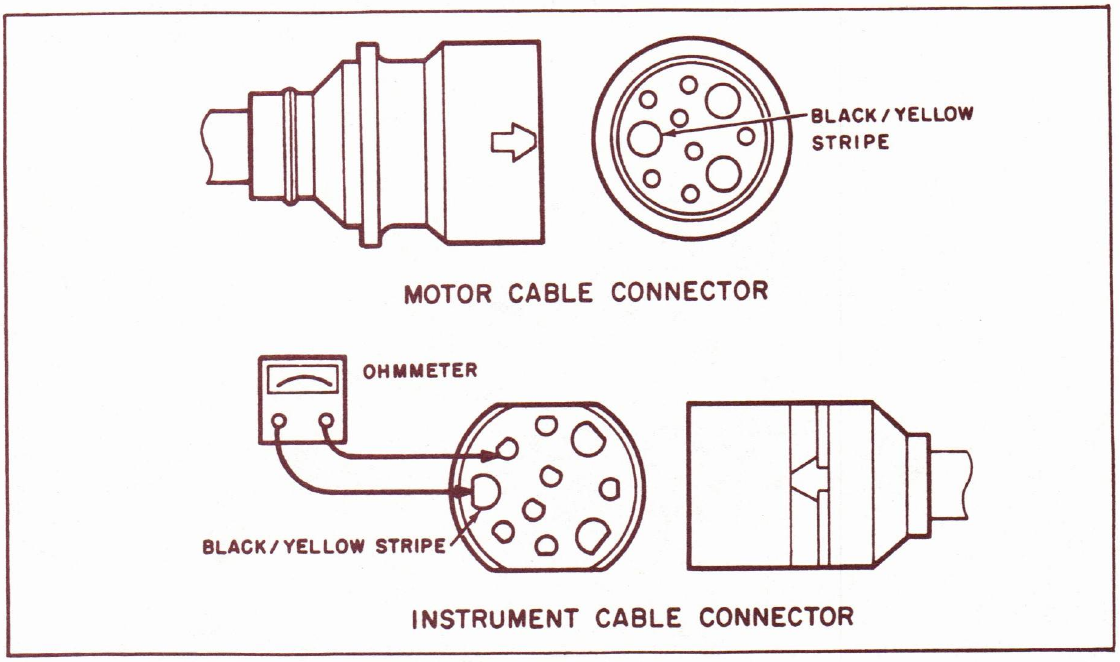
Disconnect the black/yellow stripe lead from terminal #5 on power pack. With an ohmmeter set on the hi-ohms scale, measure the resistance from the black/yellow stripe lead to ground. The meter reading should be 500,000 (500K) ohms or higher. If the ohmmeter shows less than 500,000 ohms, open the connectors (motor cable to instrument cable) to determine which terminal housing may be causing the problem.
If the meter shows less than 500K ohms when the connectors are separated, the problem is the motor cable connector.
If the meter shows more than 500K ohms when connectors are separated, disconnect the black/yellow stripe lead from the key switch, and measure the resistance between black/yellow pin in the instrument cable connector half and all other pins in the connector. If a test of less than 500K ohms is found, the problem is the instrument cable connector.
If no low resistance path is found in connector, check key switch between "M terminals". If low resistance path is found, replace switch.
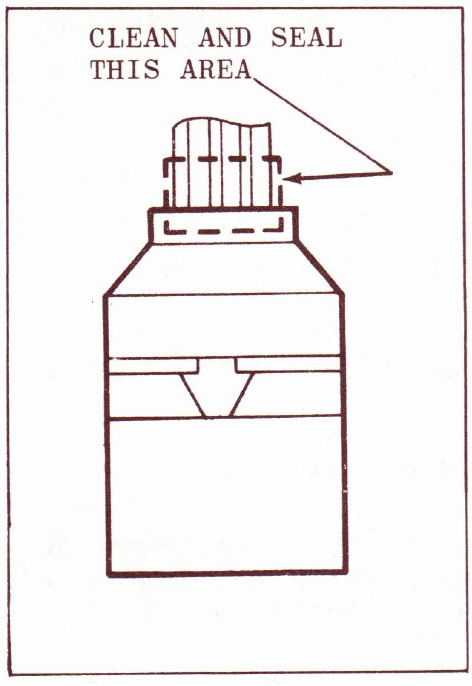
To clean out connector area shown in figure 2 use Tempo Spray Cleaner 20-013 or equivalent. Use heat to thoroughly dry the connector and seal with Neoprene Dip (#315417). Hold connector vertical so sealer will penetrate into housing. Recheck resistance with ohmmeter.
Do not attach any other leads to the M terminals on key switch. This could create a leakage path.
JOHNSON MOTORS
Doug Cankar
Technical Data Coordinator
DC:sn
NOTE: Post on your 50 H.P. index under the heading "Electrical".