Johnson Service Bulletin SB-1265 (July 1971) - 1971 50 H.P. Service Tips
Factory procedures for carburetor synchronization, ignition diagnosis, wiring-harness connectors, and cooling-system checks on 1971 Johnson 50 HP outboards.

SB-#1265
July, 1971
SUBJECT: 1971 50 H.P. SERVICE TIPS
Poor idle characteristics have been traced to improper carburetor adjustments, improper synchronization, improper timing, incorrect spark plugs, and inoperative pressure control valve or thermostat. This bulletin will outline the procedures for checking these items.
1. Carburetion
A. The following list gives the order in which carburetor adjustments are to be made. This order must be followed. Section B will give details of adjustments.
1. Set timing pointer.
2. Synchronize the carburetor butterfly valves so that both valves fully close in the closed throttle position. Further, they should be adjusted to open at precisely the same time.
3. Adjust center of cam follower to scribe mark on throttle cam.
4. Start engine and adjust idle speed screw to obtain 3° on timing grid. Stop engine.
5. Adjust the throttle cam yoke so that scribe mark aligns with center of cam follower.
6. Set idle mixture needles to 5/8 turn open. Then restart engine and readjust the idle speed adjustment screw to obtain 750 to 800 rpm in forward gear.
7. Adjust the full spark advance stop screw to obtain a timing setting of 19° at 3500 or higher rpm in forward gear. Stop engine.
8. Adjust the throttle stop screw with the throttle lever in full throttle position to obtain .010 to .020 clearance between the throttle cam and the throttle arm roller.
9. Restart engine and adjust the low-speed mixture needles to obtain the highest rpm in gear. Continue to adjust idle speed adjustment screw to obtain 700 rpm maximum in reverse gear.
CAUTION: DO NOT SET IDLE MIXTURE SCREWS LESS THAN 1/2 TURN OPEN, OR ENGINE WILL RUN LEAN AT MID-RANGE.
PAGE 2 SERVICE BULLETIN SB-#1265JOHNSON MOTORS, DIVISION OF OUTBOARD MARINE CORPORATION, WAUKEGAN, ILLINOIS 60085
B. The following are the details for all adjustments outlined in Section A.
1. On all 1971 50 HP engines the timing pointer can be set by centering the pointer on the top of the boss and also aligning the edges of the pointer with the edges of the boss. Testing of production motors has shown that this will bring the pointer into the allowable tolerance. THE THREE-AND FOUR-CYLINDER ENGINES MUST BE SET WITH TOOL #384887 AS DESCRIBED IN SERVICE MANUALS. USE CAUTION WHEN TIGHTENING THE POINTER SCREW TO KEEP FROM COCKING THE POINTER.
2. The object of the following steps is to eliminate all backlash in the carburetor linkage. This procedure is also recommended for the three- and four-cylinder engines.
Refer to 1971 50 HP Service Manual, page 3-11, figure 3-23.
a. Move throttle linkage to idle position.
b. Loosen the cam follower screw so that cam follower will not touch cam.
c. Loosen the throttle link fastener screw so that you have a sliding friction fit between the linkage and the clamp.
d. Hold the throttle shaft lever on the carburetor with the cam follower (bottom carburetor) in the closed position.
e. Now open the other carburetor butterfly valve (top carburetor) approximately 15°. This is approximately 1/6 of the way open.
f. Let go of the carburetor with the cam follower (bottom carburetor).
g. Now grasp the butterfly valve lever of the other carburetor (top carburetor) and manually close the butterfly valve.
h. Carefully tighten the throttle link fastener screw (refer to "c" above).
Over-tightening the throttle link fastener screw can alter the linkage adjustment because the screw will rub against the throttle link.
i. Readjust the cam follower to the cam scribe mark.
You have properly adjusted the linkage when the butterfly valves open at precisely the same time, not when they are just closed at the same time, although it is necessary that the butterfly valves be in the closed position for proper idle.
PAGE 3 SERVICE BULLETIN SB-#1265JOHNSON MOTORS, DIVISION OF OUTBOARD MARINE CORPORATION, WAUKEGAN, ILLINOIS 60085
3. See page 3-11, paragraph a. and b. of THROTTLE CAM ADJUSTMENT, 1971 50 HP Service Manual.
4., 5., 6. See corrected page 4-11, SYNCHRONIZING CARBURETOR AND TIMER LINKAGE, 1971 50 HP Service Manual.
7. See corrected page 4-5, 1971 50 HP Service Manual.
8. See corrected page 3-12, paragraph c. of THROTTLE CAM ADJUSTMENT, 1971 50 HP Service Manual.
9. Engine must be at operating temperature. Adjust mixture needles to obtain highest rpm and smooth operation in gear. If the engine dies when shifted to reverse, richen the low speed needles to obtain smooth operation in reverse - the hydroelectric shift mechanism requires more engine power in reverse, also, a regular propeller in gear at idle requires more engine power than a test propeller in gear at idle, so you may have to richen the mixture slightly if engine dies when shifted to reverse when installed on the boat. If all above adjustments are made properly, the engine will idle at 700 rpm in reverse, 750-800 rpm in forward, and 800-900 rpm in neutral.
C. If engine runs erratically at high speed, check the high speed orifices.
II. Ignition System
A. The bench test of the Power Pack II, as described on pages 4-7 and 4-8 of the 1971 50 HP Service Manual, is no longer an approved method to trouble shoot the power pack. An ohmmeter will not detect certain types of failures. We, therefore, recommend using only the Merc-O-Tronic M-80 or the Stevens S-80 testers because these testers check the ignition system under a load condition. (See SB-454 and SPB-438 for ordering information on M-80 and S-80).
B. Use only Champion UL-77V plugs in the 1971 50 HP (See SB-1248).
C. If sensor assembly must be cleaned for any reason, use only denatured alcohol. The sensor must be dried immediately after being cleaned. Use of any other type of cleaning fluid or prolonged use of denatured alcohol will deteriorate the plastic and/or potting of the sensor.
D. Make the full spark advance timing in forward gear only - making adjustment in neutral will over-rev the engine.
E. On all 1971 50 HP engines the timing pointer can be set by centering the pointer on the top of the boss and also aligning the edges of the pointer with the edges of the boss. Testing of production motors has shown that this will bring the pointer into the allowable tolerance.
PAGE 4 SERVICE BULLETIN SB-#1265JOHNSON MOTORS, DIVISION OF OUTBOARD MARINE CORPORATION, WAUKEGAN, ILLINOIS 60085
THE THREE- AND FOUR-CYLINDER ENGINES MUST BE SET WITH TOOL #384887 AS DESCRIBED IN SERVICE MANUALS. USE CAUTION WHEN TIGHTENING THE POINTER SCREW TO KEEP FROM COCKING THE POINTER.
III. Electrical System
A. Field reports indicate that some dealers and customers are under the impression that the 1971 50 HP engine can be operated without a battery in the electrical system. While it is true that the ignition system does not require battery current, the starting and charging systems do, and running without a battery may result in:
1. Damage to the electrical system of the engine.
2. Damage to all electrical components of the boat, such as navigation lights, horns, radio equipment, depth finders, etc. Refer to 1971 50 HP Owners Manual, pages 11 and 12, and 1971 50 HP Service Manual, pages 7-2 and 7-3.
B. Below is a diagram of the wiring harness connectors.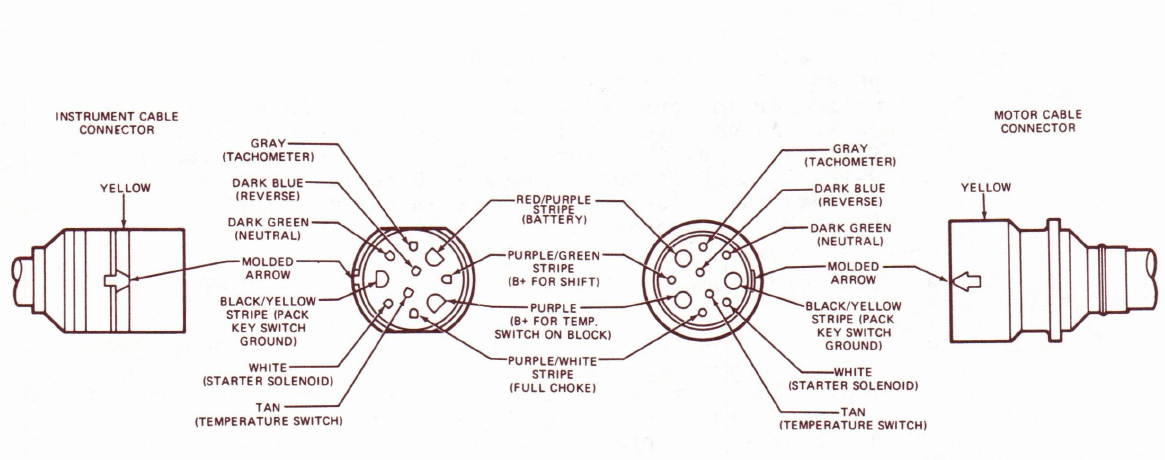
PAGE 5 SERVICE BULLETIN SB-#1265JOHNSON MOTORS, DIVISION OF OUTBOARD MARINE CORPORATION, WAUKEGAN, ILLINOIS 60085
IV. Cooling System
A. The engine should reach thermostat opening temperature (140° F.) within three minutes while running 1000 rpm or less, and should run at a maximum of 50° F. above lake or tank temperature while running above 2000 rpm. Temperature readings are to be taken at the top of the cylinder head.
B. If the engine runs too cool at low speed, check for sticking pressure control valve or defective thermostat.
C. If the engine runs too warm at high speed, check for a worn water pump, sticking pressure control valve, or incorrect pressure control valve spring.
NOTE: THE TEMPERATURE OR THE VOLUME OF THE WATER DISCHARGED FROM THE EXHAUST RELIEF OUTLET IS NOT RELATED TO ENGINE OPERATING TEMPERATURE.
JOHNSON MOTORS
Doug Cankar
Technical Data Coordinator
DC/sn
NOTE: Post on your 50 HP index under the heading "Miscellaneous".