SB-1418 - Recommended Battery Installation Procedure
Issued in May 1976, this Johnson Service Bulletin explains recommended 12- and 24-volt battery connections for electric outboards and trolling motors, including precautions against electrolytic corrosion.

SB-#1418
May, 1976
SUBJECT: Recommended Battery Installation Procedure
ON MODELS: Electric Outboards
I. 12 and 24 V Models
We recommend that separate batteries be provided for the electric
trolling motor and the primary outboard motor. Using a common battery
source for both motors may allow the electric trolling motor to dis-
charge the battery to the point where the primary motor cannot be started.
II. 24 V Models
In those instances where a 24V trolling motor is installed and space
cannot be found for separate batteries and one of the batteries is
used for both the electric outboard and the primary power source (bearing
in mind the potential problems in paragraph I above). Care must be
taken to insure that a potential electrolytic condition is not created.
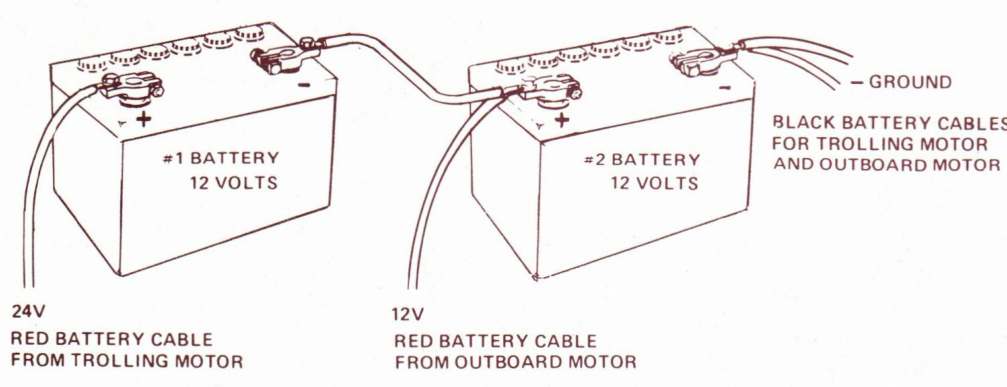
Refer to the schematic below for an approved method of connecting to
the battery source. Note the following points:
1. The outboard motor should always be connected to the #2
battery as shown.
2. The trolling motor and the outboard motor should both be
grounded at the same terminal.
3. If the outboard motor were connected to the positive and
negative terminals of the #1 battery, there would be a
12 volt potential difference between the electric motor's
ground and the outboard's ground. This difference will
cause electrolytic corrosion to occur.
JOHNSON OUTBOARDS
D. J. Leinonen
Technical Data Coordinator
NOTE: Post on your electric outboard index under heading "Motor and Electrical Group".
Related factory information
Refer to the original factory battery connection diagram when installing a 24-volt trolling motor with a shared starting battery.