
1 Battery Selector Switch - There are two switch designs, one makes contact before breaking contact, the other breaks contact before making contact during switching.
The switch that breaks contact before making contact will cause a voltage surge which will result in failure of the rectifier/regulator. Do not use this kind of switch on rectifier/regulator equipped engines.
The switch that makes contact before breaking contact can be switched safely with the engine running. If the switch has an “OFF” position, DO NOT switch to “OFF” with engine running. Switching to the “OFF” position can result in failure of the rectifier/regulator. Use the following test to determine the switch type:
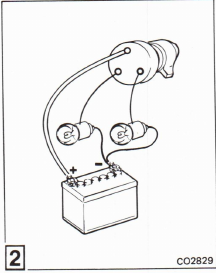
Equipment Required - One 12 volt battery, two test lights or two 12 volt light bulbs with leads attached as shown.
| Switch Position | Bulbs |
|---|---|
| “OFF” | both off |
| “1” | one light |
| “All” or “Both” | two lights |
| “2” | one light |
2 Diagnostic Procedure - Attach test lights to the battery ground terminal (-) and switch as shown. Attach a lead from the battery positive terminal to the switch. If both lights go out at any time except in “OFF” position, switch is “break before make” design and must NOT be used.
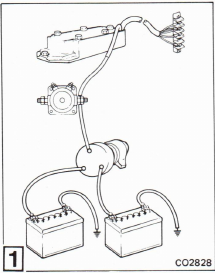
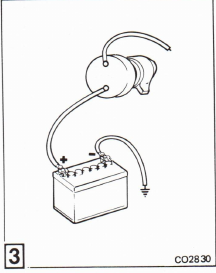
3 Battery Disconnect Switch - This switch acts as a main disconnect between the battery and the engine electrical system. DO NOT switch to “OFF” position with engine running. Switching to the “OFF” position can result in failure of the rectifier/regulator.
Electronic Battery Isolator - Do not use an electronic battery isolator with a rectifier/regulator equipped engine. When the electronic battery isolator is installed, the charging system and tachometer will not work. The charging system and tachometer will operate properly when the electronic battery isolator is removed.