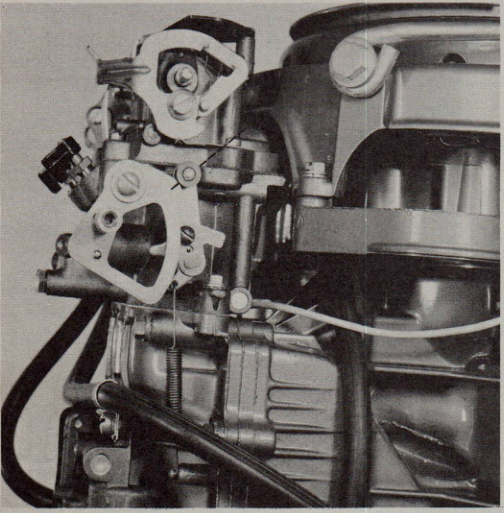
Reports have been received to the effect that some 1961 V-75 engines failed to start with the choke in automatic position due, apparently, to overchoking on cold starts. Inspections and checks of such engines reveal adjustments may be in complete accord with recommendations, yet indicate flooding.
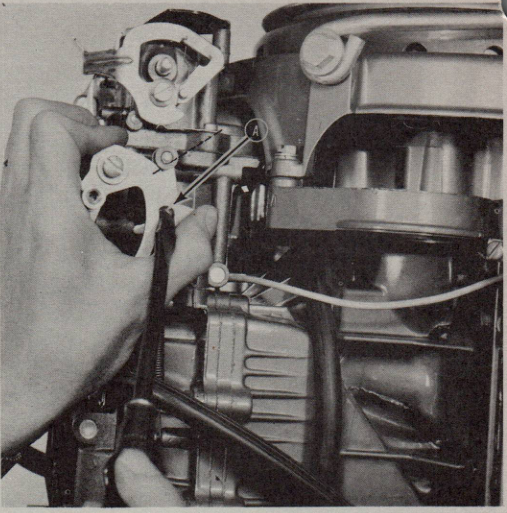
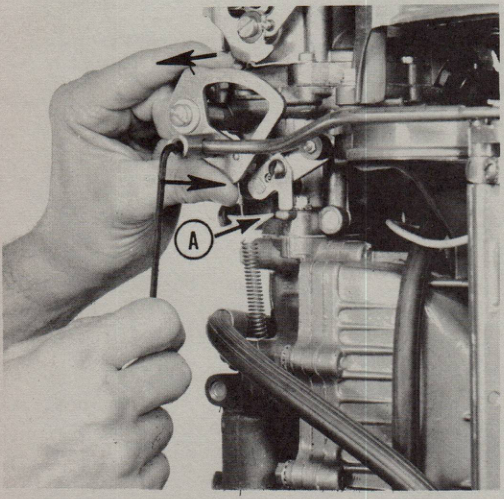
This condition can be corrected by slightly advancing the carburetor's cam which actuates the throttle roller. This means that the cam should be adjusted so the roller touches the cam to the left of the index mark similar to that illustrated in figure 2. This adjustment then causes the throttle to open a bit sooner than the normal adjustment in which the cam's index mark falls in line with the center of the cam roller. Note that this adjustment is the final one used in synchronizing the distributor, or magneto, and carburetor (see SB-739 and SB-827) except the cam's index mark is slightly advanced. The timing and synchronizing procedure remains otherwise unchanged.
The actual amount of throttle advancement will vary from engine to engine. Make the initial adjustment as illustrated in figures 2 and 3, and test it by running the engine as follows:
1. Connect tachometer 2. Run engine to obtain a normal operating temperature. 3. With ENGINE IN NEUTRAL GEAR, open throttle as far as the neutral stop and synchronizing linkage will permit. a. Engine should run at a maximum of 2500 to 3500 rpm. If less than 2500 rpm readjust cam and retest. (NOTE: Under NO circumstances must the cam be advanced farther than necessary to correct overchoking on cold starts. If the problem is not corrected with the engine running between the foregoing maximum neutral rpm range, check further for other types of malfunction.)
With the foregoing adjustments, the engine will then run somewhere between 800 and 1200 rpm immediately after a cold start when up against the neutral stop. This will enable the engine to carry through without flooding during the first few seconds of operation.
The foregoing throttle cam adjustment is not necessary on all 1961 V-75 engines, and is therefore to be made only on those engines on which the overchoking condition exists. It does not supersede the normal adjustment specified in Service Bulletins SB-739 and SB-827.