 April 5, 1963Bulletin No. SPB-337
SUBJECT: DuPont Block - Moisture and Corrosion Control
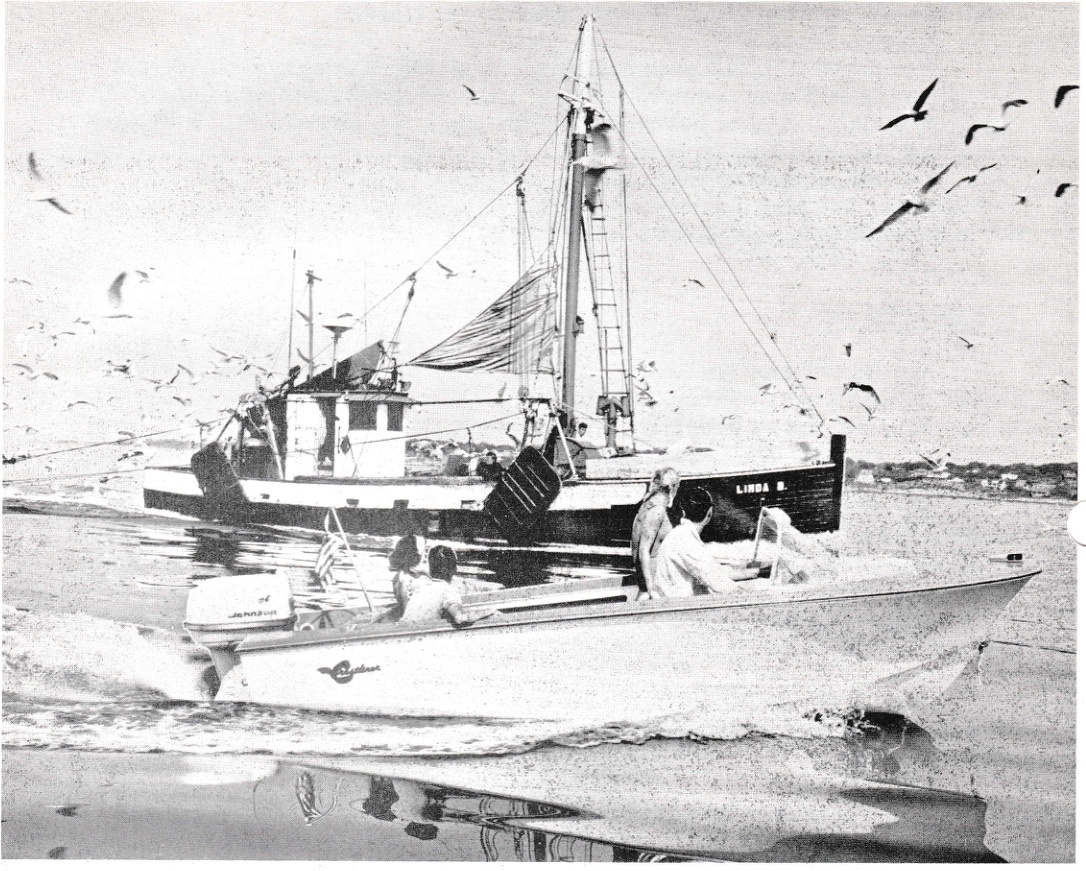
The DuPont people have been in production now for sometime on a product which ought to be of interest to many of you - particularly those of you in the salt water areas where excessive moisture and the effects of salt spray and/or salt laden air constantly prevail to interfere with the performance of mechanical and electrical installations.
It may be used for Outboard Motor, boat and trailer installations - bolted assemblies, electrical connections, the Junction Box complex, etc.
Fresh water dealers take a look too - tho not as extreme, "rust" and corrosion due to other causes make their appearance regardless, thus demanding similar control procedures.
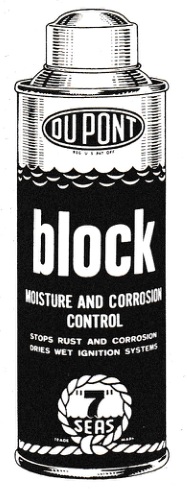
The product is DuPont Block (moisture and corrosion control), put up in 8 oz. pressurized cans for ready and convenient use but better described in a copy of their DUPONT 7 SEAS PRODUCT INFORMATION BULLETIN appearing on the following pages.
DuPont Block should be available on order to your Parts Distributors, if not, write directly to:
E.I. DUPONT DE NEMOURS AND CO., INC.
MARINE SPECIALTIES SALES,
WILMINGTON 98, DELAWARE
For source of supply and future particulars.
Service Promotion Manager
DU PONT "7" SEAS PRODUCT INFORMATION BULLETIN
BLOCK
MOISTURE & CORROSION CONTROL
1. DESCRIPTION OF COMPOSITION
Block is a liquid blend of selected solvents, lubricants and penetrating agents, packaged in an 8-ounce aerosol can. It does the following:
(a) It "displaces" films or drops of water on a solid surface by penetrating between the water and the surface. This phenomenon is known as "preferential wetting." Block is so efficient that it immediately destroys contact between water and the surface.
(b) It creeps under corrosion deposits in a similar manner, destroying their adhesion to the surfaces on which they form, and aids in their removal.
(c) It penetrates readily between close-fitting surfaces. Once it has thus penetrated, it deposits a film having both good lubrication and anti-corrosion properties. This film does not dry, harden, or become "gummy."
Some of the more important uses for Block, which rely on this remarkable combination of properties, are listed below.
2. RECOMMENDED USES
The property of displacing water gives Block the ability to "dry" wet surfaces. It is particularly useful, therefore, for helping to start wet engines in boats, automobiles, power lawnmowers, and the like. When sprayed on the wet parts - distributors, ignition coils, spark plugs, cables - it replaces the conductive layer of water, which causes short circuits, with its own non-conductive film, allowing the electricity to flow along its proper circuit. It will also "dry out" an electric motor or generator - the armature, field coils, commutator, connectors, brushes, etc. It is effective whether the water is present in drops, films or puddles. It is remarkably efficient and fast-working.
The property of loosening and lifting corrosion products makes it very convenient to use in cleaning encrusted battery terminals. Such deposits often contain grease derived from previous applications of cup grease for corrosion prevention. Block promptly cuts through the entire deposit, softens it for easy removal by wiping, and leaves a protective film on the surfaces of the clamp connectors and straps, electrodes, and cell-connector bars. Block will also loosen and remove rust deposits, although heavy rust layers had best be removed with steel wool after spraying and allowing to soak.
The penetrating action can also be employed to great advantage in loosening and lubricating rusted nuts, bolts, screws, locks, jointed tools such as pliers and shears, hinges, firearms, power tools, and many other mechanisms that bind or "freeze up" due to corrosion in storage.
The Block film has good resistance to rusting and corrosion, because (a) it is not attacked or removed by water, and (b) it wets and adheres so tightly to metals. It does not crack, chip or peel, as lacquers do. It is very useful and convenient to apply to a great many metal surfaces around the boat, home, and car, including shop tools, firearms, saws, chrome parts and accessories, and plated surfaces on bicycles and tricycles. Caution - it will not last indefinitely, and should be re-applied periodically, as required.
3. HOW TO USE
(a) On wet engines, spray liberally on all wet parts - distributor (inside and out), coil, cables, spark plugs. On wet electric motors, starters and generators, spray liberally over all exposed connections, wires, commutators, armatures, field windings. Then start.
(b) To loosen rusted bolts and nuts, etc., spray liberally, allow a few minutes for penetration, then loosen with wrench and/or screwdriver, tapping if necessary to start.
(c) To remove light rust, spray generously, allow to penetrate, wipe off, and follow with a second coat for protection.
(d) To remove heavy rust, spray thoroughly, allow to soak, then rub with fine steel wool or fine sandpaper. After removal, spray on a second coat for protection.
(e) For general penetration/lubrication, spray directly onto or into area to be treated.
4. COMMENTS ON COMPETITIVE PRODUCTS
Block has been compared with leading competitive products in many use applications, and is equal to the best of them.
The pleasant odor of Block is a distinct advantage. Many penetrating oils have a repulsive, "gas-works" odor.
No composition is known that will do so many things and do them so well.
* * *